The Israeli-Palestinian conflict is one of the world’s
major sources of instability. Americans are directly connected to this
conflict, and increasingly imperiled by its devastation.
It is the goal of '' If Americans Knew '' to provide full and
accurate information on this critical issue, and on our power – and
duty – to bring a resolution.
A Synopsis of the
Israel/Palestine Conflict
For centuries there was no such conflict. In the 19th
century the land of Palestine was inhabited by a multicultural
population – approximately 86 percent Muslim, 10 percent Christian, and 4
percent Jewish – living in peace.
Zionism
In the late 1800s a group in Europe decided to colonize
this land. Known as Zionists, they represented an extremist minority of
the Jewish population. Their goal was to create a Jewish homeland, and
they considered locations in Africa and the Americas, before settling on
Palestine.

Historic Palestine
|
At first, this immigration created no problems. However, as more and
more Zionists immigrated to Palestine – many with the express wish of
taking over the land for a Jewish state – the indigenous population
became increasingly alarmed. Eventually, fighting broke out, with
escalating waves of violence. Hitler's rise to power, combined with
Zionist activities to sabotage efforts to place Jewish refugees in
western countries, led to increased Jewish immigration to Palestine, and
conflict grew.
UN Partition Plan
Finally, in 1947 the United Nations decided to
intervene. However, rather than adhering to the principle of
“self-determination of peoples,” in which the people themselves create
their own state and system of government, the UN chose to revert to the
medieval strategy whereby an outside power divides up other people’s
land.
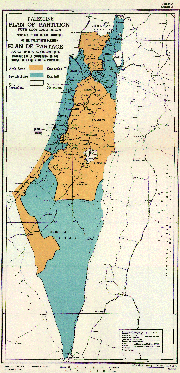
UN Plan of Partition
|
Under considerable Zionist pressure, the UN recommended giving away
55% of Palestine to a Jewish state – despite the fact that this group
represented only about 30% of the total population, and owned under 7%
of the land.
1947-1949 War
While it is widely reported that the resulting war
eventually included five Arab armies, less well known is the fact that
throughout this war Zionist forces outnumbered all Arab and Palestinian
combatants combined – often by a factor of two to three. Moreover, Arab
armies did not invade Israel – virtually all battles were fought on land
that was to have been the Palestinian state.
Finally, it is significant to note that Arab armies entered the
conflict only after Zionist forces had committed 16 massacres, including
the grisly massacre of over 100 men, women, and children at Deir
Yassin. Future Israeli Prime Minister Menachem Begin, head of one of the
Jewish terrorist groups, described this as “splendid,” and stated: “As
in Deir Yassin, so everywhere, we will attack and smite the enemy. God,
God, Thou has chosen us for conquest.” Zionist forces committed 33
massacres altogether.
By the end of the war, Israel had conquered 78 percent of Palestine;
three-quarters of a million Palestinians had been made refugees; over
500 towns and villages had been obliterated; and a new map was drawn up,
in which every city, river and hillock received a new, Hebrew name, as
all vestiges of the Palestinian culture were to be erased. For decades
Israel denied the existence of this population, former Israeli Prime
Minister Golda Meir once saying: “There is no such thing as a
Palestinian.”
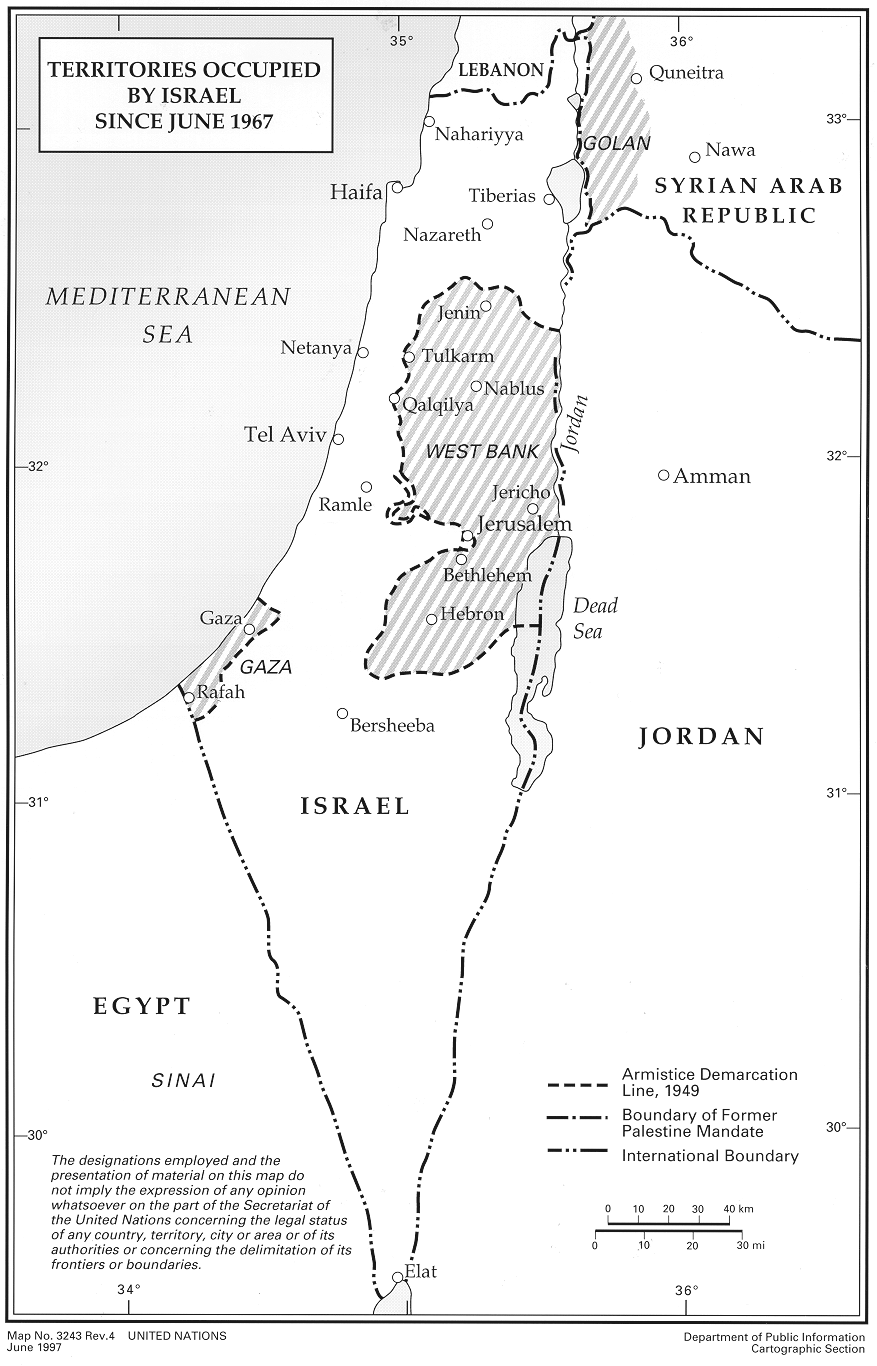
1967 Occupation
|
1967 War & USS Liberty
In 1967, Israel conquered still more land. Following
the Six Day War, in which Israeli forces launched a highly successful
surprise attack on Egypt, Israel occupied the final 22% of Palestine
that had eluded it in 1948 – the West Bank and Gaza Strip. Since,
according to international law it is inadmissible to acquire territory
by war, these are occupied territories and do not belong to Israel. It
also occupied parts of Egypt (since returned) and Syria (which remain
under occupation).
Also during the Six Day War, Israel attacked a US Navy ship, the USS
Liberty, killing and injuring over 200 American servicemen. President
Lyndon Johnson recalled rescue flights, saying that he did not want to
"embarrass an ally." (In 2004 a high-level commission chaired by Admiral
Thomas Moorer, former Chairman of the Joint Chiefs of Staff, found this
attack to be “an act of war against the United States,” a fact few news
media have reported.)
Current Conflict
There are two primary issues at the core of this
continuing conflict. First, there is the inevitably destabilizing effect
of trying to maintain an ethnically preferential state, particularly
when it is largely of foreign origin. The original population of what is
now Israel was 96 percent Muslim and Christian, yet, these refugees are
prohibited from returning to their homes in the self-described Jewish
state (and those within Israel are subjected to systematic
discrimination).
Second, Israel's continued military occupation and confiscation of
privately owned land in the West Bank, and control over Gaza, are
extremely oppressive, with Palestinians having minimal control over
their lives. Over 10,000 Palestinian men, women, and children are held
in Israeli prisons. Few of them have had a legitimate trial; Physical
abuse and torture are frequent. Palestinian borders (even internal ones)
are controlled by Israeli forces. Periodically men, women, and children
are strip searched; people are beaten; women in labor are prevented
from reaching hospitals (at times resulting in death); food and medicine
are blocked from entering Gaza, producing an escalating humanitarian
crisis. Israeli forces invade almost daily, injuring, kidnapping, and
sometimes killing inhabitants.
According to the Oslo peace accords of 1993, these territories were
supposed to finally become a Palestinian state. However, after years of
Israel continuing to confiscate land and conditions steadily worsening,
the Palestinian population rebelled. (The Barak offer, widely reputed to
be generous, was anything but.) This uprising, called the "Intifada"
(Arabic for "shaking off") began at the end of September 2000.
U.S. Involvement
Largely due to special-interest lobbying, U.S.
taxpayers give Israel an average of $8 million per day, and since its
creation have given more U.S. funds to Israel than to any other nation.
As Americans learn about how Israel is using our tax dollars, many are
calling for an end to this expenditure.



.jpg)